
A solubility limitation, an unstable polymorph, a hygroscopic active pharmaceutical ingredient (API) or an incompatible excipient does not disappear because it was not measured. It reappears later — during stability studies, at the exhibit batch, or at scale-up — when resolving it means a repeated study, a revised formulation and a delayed submission rather than a single characterisation experiment.
Preformulation development is the least expensive point in a programme at which a product-limiting property can be identified. For first-to-file strategies, tender commitments, global launch sequences and investor-backed pipelines, that timing has a commercial dimension as well as a scientific one: characterisation completed early narrows the formulation options that need to be trialled, supports a realistic development timeline, and helps minimise the rework that extends programmes.
It also changes the quality of the conversation with a regulator. Data generated deliberately, under an approved protocol, is easier to defend than data assembled retrospectively to explain a problem that has already occurred.
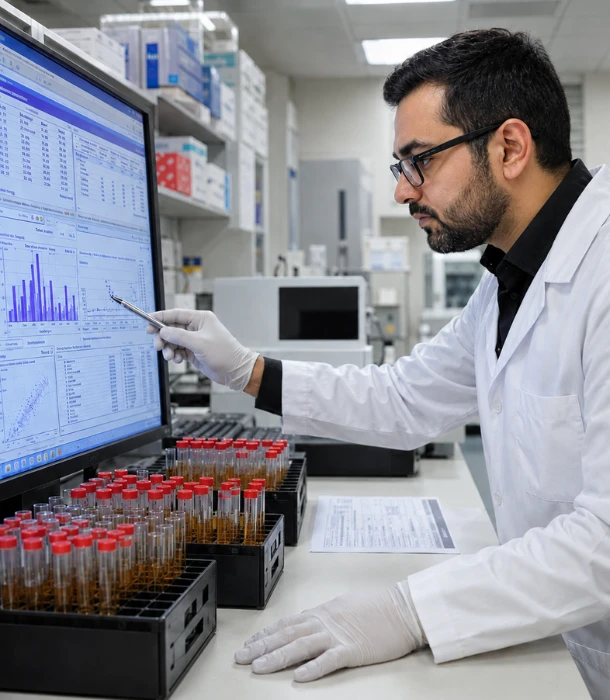
Pharmaceutical preformulation is the characterisation stage between an available drug substance and a designed dosage form. It establishes how the API behaves on its own and in the presence of candidate excipients, so that formulation decisions are made against measured physicochemical properties instead of assumed ones. Four groups of properties carry most of the decision weight.
Solubility across the physiological pH range, ionisation behaviour (pKa), partitioning (log P and log D) and hygroscopicity — the properties that govern dissolution, absorption and handling.
Crystalline and amorphous forms, polymorphs, hydrates, solvates and salt forms, with their thermal behaviour — the form selected here determines stability and manufacturability downstream.
Particle size distribution and morphology, bulk and tapped density, compressibility and flowability — the properties that decide whether the API can be processed by the intended route.
Intrinsic stability under hydrolytic, oxidative, thermal and photolytic stress, together with compatibility against candidate excipients, identifying degradation pathways before they reach a formulation.
Together these four groups form the evidence base that pharmaceutical preformulation exists to produce: enough measured information to select a dosage form, an excipient set and a manufacturing route with a documented scientific reason for each choice.
Solubility study, excipient compatibility study, forced-degradation study, reverse engineering of reference products, polymorphism screening, particle size determination and powder-flow determination — designed as a defined scope of work against your target product profile, not as a fixed test panel.
Equilibrium and kinetic solubility across the physiological pH range and in relevant buffers, co-solvent and surfactant systems, establishing the dissolution and bioavailability constraints the formulation must work within.
Determination of pKa, log P and log D to indicate where in the gastrointestinal tract the molecule is likely to be ionised or unionised, informing dosage-form and salt-selection decisions.
Polymorph, hydrate and salt-form screening with thermal and diffraction characterisation, to identify the solid form best suited to the stability and manufacturability requirements of the intended product.
Particle size distribution and morphology, bulk and tapped density, compressibility index and flowability determination, establishing whether the API can be processed by the proposed manufacturing route.
Hydrolytic, oxidative, thermal and photolytic stress testing to identify degradation pathways and generate the impurity profile needed to support stability-indicating analytical method development.
Binary and multi-component compatibility studies under accelerated temperature and humidity conditions, screening out interacting excipients before they are committed to a formulation.
Comparative characterisation of the reference product to establish the qualitative and quantitative targets a generic formulation is expected to meet, supporting a defensible development rationale.
Moisture-sorption and uptake determination to define the handling, drying and packaging requirements for moisture-sensitive and deliquescent molecules.
Pharmaceutical preformulation data is only as defensible as the analytical methods that generate it. Characterisation is supported by Molkem Labs' analytical research and development function, so that methods are established, documented and traceable rather than assembled study by study.
The characterisation questions differ by product route. A generic programme is measured against a reference product; a patented molecule is measured against a target product profile that does not yet exist; a difficult API is measured against whether it can be handled at all.
Reverse engineering of the reference product, comparative physicochemical and dissolution characterisation, and identification of the solid form and excipient set required to match it — establishing the development rationale that supports a bioequivalence strategy, where applicable coordinated through qualified Contract Research Organisation (CRO) partners.
Developability assessment for molecules with no established precedent, conducted under proof of concept and aligned with Quality by Design (QbD) principles, establishing which dosage forms are scientifically feasible before development capital is committed to any one of them.
Characterisation and handling assessment for hygroscopic, thermolabile and deliquescent molecules, defining the environmental controls, processing constraints and packaging requirements a viable formulation will depend on.
A preformulation programme is purchased for the decisions it enables, not for the tests it contains. Each engagement is designed to close with a documented position on what the molecule will and will not support.
Six defined stages, each with an agreed output, so that scope, cost and timeline are established before laboratory work begins.
A Non-Disclosure Agreement (NDA) is signed before molecule details are shared. The product concept, target market and intended dosage form are reviewed against the information already available to you.
Existing data is reviewed, characterisation gaps are identified, and a recommended scope of work, development timeline and cost proposal are issued, with no obligation to proceed.
The study plan is defined against the target product profile and the applicable regulatory expectations, and approved by you before any work is executed.
Methods for assay, related substances and dissolution are established or transferred so that every characterisation result generated is measurable, reproducible and traceable.
Solubility, solid-state, powder, stress and drug–excipient compatibility studies are performed under the approved protocol, with results recorded under the quality management system.
Findings are consolidated into the preformulation report. The feasible dosage forms, solid-form recommendation and excipient shortlist are carried directly into formulation development.
Treating pharmaceutical preformulation and formulation as one continuous programme removes a common source of delay. Where characterisation and formulation sit with different organisations, data is frequently regenerated, analytical methods are re-established, and assumptions that were already tested are tested again — none of which advances the submission.
At Molkem Labs the preformulation dataset carries directly into formulation development, analytical method validation, stability studies, regulatory dossier preparation and, where applicable, technology transfer and exhibit batches, with commercial-scale manufacturing coordinated through qualified Contract Manufacturing Organisations (CMOs). The same team that measured the molecule designs the product around it.
Characterisation data is recorded with the traceability and data-integrity controls expected of development data intended for regulatory review, and structured so that it can support the quality sections of a Common Technical Document (CTD/eCTD) submission. Study design follows ICH quality guidelines where they apply to the molecule and product route.
Preformulation data is generated with the destination market in view, including CDSCO (India), US FDA, EMA, ANVISA, Health Canada, TGA, NMPA and Rest of World (ROW) markets. The characterisation itself is largely market-independent; the documentation expectations are not, and defining the intended markets at the outset helps avoid regenerating data later to satisfy a requirement that was not anticipated.
Studies are executed within a risk-based quality management system, in analytical laboratories operating under 21 CFR-compliant systems and NABL-accredited capabilities, with defined protocols, controlled records and reviewed reports. The intent is straightforward: data that does not need to be defended by explanation.
Preformulation is usually the first stage of a programme placed with an external partner, and it is the stage at which a molecule or a reference-product strategy is least protected. Every enquiry is treated as confidential, and molecule-specific information is reviewed under a signed Non-Disclosure Agreement (NDA) before technical discussion begins.
Project-specific intellectual property ownership is defined in the agreement between the parties. Your molecule, data, formulations and proprietary information are protected throughout the development programme, and Molkem Labs leads and manages the development work rather than asserting a claim over your product.
Access to project information is restricted to the personnel working on it, records are maintained under the quality management system, and materials, data and reports are handled under defined controls for the duration of the engagement.
R&D and product-development teams building generic and value-added portfolios who need reference-product characterisation, solid-form selection and excipient screening completed to a documented standard — either because in-house capacity is committed elsewhere, or because a specific molecule requires characterisation the internal laboratory is not equipped for.
Small-to-mid pharmaceutical companies outside India establishing development work with an Indian partner, who need characterisation performed and documented to expectations their own regulatory affairs function can carry into a submission in their destination markets.
Preformulation development is the characterisation of a drug substance's physicochemical properties — solubility, ionisation, solid-state form, powder behaviour, stability and excipient compatibility — before a dosage form is designed. It should begin as soon as sufficient API is available and a product concept exists. Starting it before formulation trials means the trials are designed around what the molecule actually does, rather than being used to discover it.
Pharmaceutical preformulation measures the molecule. Formulation development designs a product around what was measured. Preformulation answers which dosage forms are feasible, which excipients are safe to use and what the stability risks are; formulation development then builds and optimises the composition and process. Running them as separate, disconnected projects is where most avoidable rework originates.
Yes. Molkem Labs is a development-focused organisation, and preformulation, formulation development, analytical method development and validation, stability studies and regulatory dossier preparation can be managed as one integrated programme with a single point of accountability. Commercial-scale manufacturing is coordinated through qualified Contract Manufacturing Organisations (CMOs). You can also engage the preformulation stage on its own.
It depends on which studies are in scope. Solubility, thermal and diffraction work needs relatively little material; forced-degradation, compatibility and powder-characterisation studies need more. The initial developability assessment includes an indicative material requirement for the recommended scope, so you can plan API supply before committing to the programme.
Yes. For generic and ANDA-route products the work is anchored to the reference product: comparative physicochemical characterisation, dissolution comparison and reverse engineering establish the qualitative and quantitative targets the generic formulation is expected to meet, which in turn supports the development rationale behind a bioequivalence strategy.
Cost is driven by the number and type of studies in scope, the complexity of the molecule, whether analytical methods already exist or must be developed, the extent of solid-form and compatibility screening required, and the destination markets the documentation must satisfy. A cost proposal is issued with the recommended scope of work following the initial assessment, so pricing is tied to a defined scope rather than quoted in the abstract.
Molecule-specific information is reviewed only under a signed Non-Disclosure Agreement. Project-specific intellectual property ownership is defined in the agreement between the parties, access to project information is restricted to the personnel working on it, and records are maintained under the quality management system for the duration of the engagement.
Preformulation data is generated with the destination market defined at the outset, covering CDSCO (India), US FDA, EMA, ANVISA, Health Canada, TGA, NMPA and Rest of World markets. The underlying characterisation is largely market-independent, but documentation expectations differ, so confirming target markets before the protocol is approved helps avoid regenerating data later.
Share details of your molecule or product concept. Our business development executive will respond with an initial developability assessment, the recommended scope of work for preformulation development, a realistic development timeline and a cost proposal — under a signed Non-Disclosure Agreement (NDA), with no obligation to proceed.
Every enquiry is treated as confidential. Confidential materials are reviewed under a signed Non-Disclosure Agreement. You can also email hello@molkem.com.


 Global - English
 Brazil - Portuguese
 Thailand - Thai
 Middle East - Arabic
 Vietnam - Vietnamese
 Spain - Spanish
 Colombia - Spanish
 Argentina - Spanish