
Nitrosamine impurity testing is the three-step process by which a manufacturer establishes whether a medicine contains N-nitrosamine impurities above the acceptable intake limit set by the regulatory authority, and what must change if it does: risk evaluation, confirmatory testing, and control.
N-nitrosamines form when a secondary or tertiary amine meets a nitrosating agent such as nitrite, and several are classified as probable or possible human carcinogens. Because authorities set their limits as an acceptable intake in nanograms per day rather than as an impurity percentage, nitrosamine analysis has to measure a trace target in a matrix many orders of magnitude more concentrated, with enough selectivity to defend the result during assessment.
The synthetic route, starting materials, reagents, solvents, catalysts, excipients, water, equipment and packaging are examined to establish whether a nitrosamine could plausibly form or be carried over, and which compounds are credible.
Where the evaluation identifies a risk, a specific, sensitive and validated method is used to determine whether the nitrosamine is actually present, and at what level relative to the applicable limit.
A confirmed finding is traced to its source and addressed through process, supplier, formulation, packaging or specification changes, and the resulting control strategy is documented for the submission.
Since the sartan recalls of 2018, nitrosamine control has moved from an exceptional investigation to a standing expectation. Marketing authorisation holders and manufacturers are required to evaluate every product for nitrosamine risk, to confirm by testing where that evaluation identifies one, and to maintain a documented control strategy. The obligation does not end at approval: it is re-triggered by a change of supplier, route, excipient, packaging component or manufacturing site.
The commercial consequence is a matter of timing rather than science. A query from a regulatory authority, a customer requirement ahead of shipment, a pending submission or a batch awaiting release each arrive with a date attached, and confirmatory data cannot be generated retrospectively once that date has passed. Developing a suitable method, validating it and analysing the samples is a defined piece of work that takes the time it takes.
The requirement is broad in scope. It applies to generic and branded finished products, to API manufacturers supplying regulated markets, to companies whose risk evaluation has flagged an amine-containing molecule, and to organisations responding to a deficiency letter or an importer's data request. Where the molecule itself carries a nitrosatable amine, a generic panel will not answer the question and a molecule-specific method has to be developed.

Molkem Labs supports the analytical half of a nitrosamine programme, from scoping the question through to a report that can be placed in a dossier.
Technical review of the synthetic route, raw materials, excipients, process aids, water and packaging to identify credible nitrosamine formation and carry-over pathways, and to decide which compounds warrant confirmatory testing.
Fit-for-purpose methods for nitrosamine analysis, with sensitivity matched to the applicable acceptable intake limit and the maximum daily dose, and selectivity established against the product matrix. This includes molecule-specific NDSRI method development, where the API itself is the amine source and no pharmacopoeial procedure exists.
Validation in line with ICH Q2(R2) expectations for specificity, linearity, accuracy, precision, range, limit of detection and limit of quantitation, generating the documentation an assessor expects to see.
Nitrosamine impurity analysis of drug substance and drug product samples, with nitrosamine detection and quantification reported against the applicable limit and supported by system suitability and reference standard data.
Nitrosamine analytical testing of excipients, raw materials, intermediates and recovered solvents, supporting supplier qualification and the identification of nitrite-bearing inputs.
Assessment of whether nitrosamine levels change over the shelf life or under stress, integrated with forced degradation and the stability programme conducted under ICH conditions.
Method development and validation reports, analytical reports and the written control-strategy rationale, prepared for inclusion in the Common Technical Document by our regulatory services team.
Nitrosamine risk is distributed across the supply chain rather than concentrated in the finished product, so the nitrosamine testing scope usually extends beyond the drug product itself.
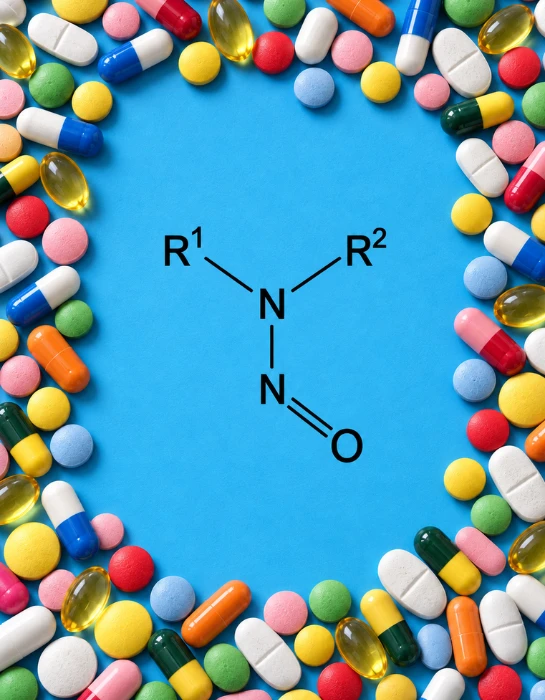
A nitrosamine requires two things: an amine and a nitrosating agent. Both are common, which is why the impurity appears in processes that were never designed to produce it. Understanding which pathway applies is what makes the difference between a test result and an actionable finding.
A nitrosamine result is only as useful as the method behind it. The decisions that determine whether data survives assessment are taken during method development, not during analysis.
Because acceptable intake limits are expressed in nanograms per day, the reporting threshold that actually matters depends on the maximum daily dose of the product. A method is developed so that its limit of quantitation sits well below the concentration corresponding to the applicable limit, which is what allows a result to be reported as compliant rather than merely as not detected.
Trace nitrosamine detection is vulnerable to interference from the matrix it sits in. Sensitive chromatographic and mass-spectrometric techniques are selected and optimised for the specific product, so that the signal being measured is demonstrably the target compound and not a co-eluting or isobaric response from the formulation.
Nitrosamines can be generated during sample preparation itself if an amine and a nitrosating agent are brought together under acidic conditions. Preparation is therefore designed to suppress in-situ formation, and appropriate controls are run so that a reported result reflects the product as manufactured rather than the laboratory procedure applied to it.
Methods are validated in line with ICH Q2(R2) expectations and documented so that a reviewer can follow the rationale from the risk evaluation through to the reported value. Where a pharmacopoeial or authority-published procedure is suitable, it is verified for the specific product rather than adopted without evidence.
Nitrosamine expectations are set by several authorities at once, and they are not identical. A programme intended to support more than one market has to be designed against the strictest applicable limit rather than the most convenient one.
The governing principle is ICH M7(R2), which covers the assessment and control of DNA-reactive, mutagenic impurities. On top of it, the US FDA maintains Control of Nitrosamine Impurities in Human Drugs, revised in September 2024, together with a separately maintained list of recommended acceptable intake limits. The European Medicines Agency maintains its own acceptable intake list under the Article 5(3) referral. Both agencies now derive limits for nitrosamine drug substance-related impurities using the Carcinogenic Potency Categorisation Approach (CPCA), which assigns a compound to one of five potency categories from its structural features.
The pharmacopoeias carry their own nitrosamine chapters alongside those authority positions. United States Pharmacopeia General Chapter <1469> Nitrosamine Impurities has been official since December 2021, European Pharmacopoeia general chapter 2.5.42 N-Nitrosamines in active substances has been in force since January 2022, and Indian Pharmacopoeia General Chapter 5.11 has applied since December 2022. These give compendial analytical procedures and control expectations rather than acceptable intake limits, which remain with the authorities, so a programme is normally designed against both.
| Potency category | US FDA acceptable intake (ng/day) | EMA acceptable intake (ng/day) |
|---|---|---|
| Category 1 (highest potency) | 26.5 | 18 |
| Category 2 | 100 | 100 |
| Category 3 | 400 | 400 |
| Category 4 | 1,500 | 1,500 |
| Category 5 (lowest potency) | 1,500 | 1,500 |
Scroll the table sideways to see all columns.
India now has its own reference materials for this work. The Indian Pharmacopoeia Commission released seven Indian Pharmacopoeia Nitrosamine Impurities Reference Standards in August 2026, covering the compounds most frequently named in risk evaluations. These are also the seven nitrosamines most commonly asked about, and the table below gives each one with its full chemical name and the limit currently recommended by the US FDA.
| Abbreviation | Chemical name | CPCA potency category | US FDA recommended AI (ng/day) |
|---|---|---|---|
| NDMA | N-Nitrosodimethylamine | Compound-specific | 96 |
| NDEA | N-Nitrosodiethylamine | Compound-specific | 26.5 |
| NEIPA | N-Nitrosoethylisopropylamine (also cited as NIPEA) | 3 | 400 |
| NDBA | N-Nitrosodibutylamine | Not currently listed | Not listed — derive from the applicable authority's approach |
| NMPA | N-Nitrosomethylphenylamine (N-nitroso-N-methylaniline) | 2 | 100 |
| NDIPA | N-Nitrosodiisopropylamine | 5 | 1,500 |
| NMBA | N-Nitroso-N-methyl-4-aminobutyric acid | 4 | 1,500 |
Scroll the table sideways to see all columns.
Limits shown are the values published by the US FDA and verified against its live list on 23 October 2026. NDMA and NDEA carry compound-specific limits; the others are derived from their CPCA potency category. NDBA does not currently appear on the FDA list. Acceptable intake limits are revised periodically and EMA values differ for several compounds, so the applicable limit should always be confirmed against the live lists maintained by the US FDA and the European Medicines Agency before a specification is set.
Indian Pharmacopoeia 2022 introduced General Chapter 5.11 on nitrosamine impurities, effective from December 2022, giving Indian manufacturers a domestic reference point alongside the ICH, FDA and EMA frameworks. For companies supplying both the Indian market and regulated export markets, the practical effect is that a single nitrosamine programme has to satisfy the Central Drugs Standard Control Organisation (CDSCO) and the importing authority at the same time. Molkem Labs structures analytical work and documentation for the markets a product is actually intended for, which may include CDSCO, US FDA, EMA, ANVISA, Health Canada, TGA, NMPA and Rest of World (ROW) submissions.
A test report states what was found. It does not, on its own, resolve the finding. Because Molkem Labs is a development organisation rather than a testing laboratory alone, a confirmed nitrosamine detection can be followed through into the work that actually removes it.
The confirmed result is traced back through the route, the materials, the equipment and the packaging to establish which pathway is responsible, since the remedy differs entirely depending on the answer.
Where the source is a reagent, a recovered solvent or a supplied input, the options are evaluated as process or sourcing changes, with technology transfer and commercial-scale implications coordinated through qualified Contract Manufacturing Organisation (CMO) partners where applicable.
Where formation occurs in the product rather than the process, our formulation development team evaluates composition-level options such as pH control, excipient substitution and the use of appropriate scavenging agents, supported by preformulation data.
Container-closure components and storage conditions are reassessed where the evidence points to transfer from packaging or to formation over shelf life rather than at manufacture.
A control approach is defined, whether that is a release specification, a skip-testing justification, an upstream control or a demonstrated absence of risk, with the supporting analytical evidence assembled behind it.
The investigation, the method, the validation and the control rationale are written up for the Common Technical Document, so that the answer reaches the assessor in the form the assessment requires.
Nitrosamine work involves sharing the one thing a pharmaceutical company is least willing to share: the molecule, the route and an unresolved quality problem. The controls below exist for that reason.
Enquiries and materials are reviewed under a signed Non-Disclosure Agreement (NDA). Project-specific intellectual property ownership is defined in the agreement, and the customer's molecule, synthetic route, analytical data and proprietary information are protected throughout the programme. Samples are handled under controlled receipt and chain-of-custody procedures, and project information is restricted to the team assigned to the work. A nitrosamine finding is commercially sensitive as well as technically sensitive, and it is treated accordingly.
Analytical work is conducted within a cGMP-compliant laboratory environment supported by 21 CFR compliant systems, so that raw data, audit trails and reported results remain attributable and traceable from sample receipt to final report. For trace-level nitrosamine impurity analysis this matters more than usual: where a result sits close to a limit, the credibility of the conclusion rests on the integrity of the record behind it as much as on the measurement itself.
Work is performed under a documented Quality Management System (QMS) covering method development, validation, analyst qualification, instrument performance, reference standard management and deviation handling, with NABL-accredited capabilities supporting the analytical laboratory. Documentation is prepared so that it can be submitted as received, aligned with the requirements of the authority the product is intended for, including the Central Drugs Standard Control Organisation (CDSCO), US FDA, EMA, ANVISA, Health Canada, TGA, NMPA and Rest of World (ROW) markets.
The seven most commonly named N-nitrosamines are NDMA (N-nitrosodimethylamine), NDEA (N-nitrosodiethylamine), NEIPA (N-nitrosoethylisopropylamine), NDBA (N-nitrosodibutylamine), NMPA (N-nitrosomethylphenylamine), NDIPA (N-nitrosodiisopropylamine) and NMBA (N-nitroso-N-methyl-4-aminobutyric acid). These are the seven for which the Indian Pharmacopoeia Commission released reference standards in August 2026. They are not the full list: authorities maintain longer tables, and nitrosamine drug substance-related impurities are specific to individual molecules and sit outside any fixed set of seven.
You check in three stages. First a risk evaluation of the route, materials, equipment and packaging establishes whether a nitrosamine could form or carry over and which compounds are plausible. Second, where a risk is identified, confirmatory testing uses a specific and sufficiently sensitive validated method to determine whether the compound is actually present and at what level; reliable nitrosamine detection at these concentrations depends on the method being developed for your particular matrix rather than adopted generically. Third, a confirmed result is traced to its source and controlled. Skipping the first stage is the most common cause of wasted analytical work, because it leads to testing for compounds that could never have formed.
ICH M7(R2), covering the assessment and control of DNA-reactive (mutagenic) impurities in pharmaceuticals to limit potential carcinogenic risk, is the governing ICH guideline. It establishes the principles under which nitrosamines are treated as a cohort of concern. It is applied alongside the US FDA guidance Control of Nitrosamine Impurities in Human Drugs, the EMA's requirements for marketing authorisation holders, and Indian Pharmacopoeia General Chapter 5.11. Analytical method validation follows ICH Q2(R2).
NDMA, or N-nitrosodimethylamine, is the smallest and most widely reported nitrosamine, and the compound found in the sartan, ranitidine and metformin products that prompted the current regulatory framework. NDMA analysis is required whenever a risk evaluation identifies a plausible formation or carry-over pathway, typically where dimethylamine or a dimethylamine-generating reagent is present in the route, where a contaminated or recovered input is used, or where shared equipment creates a cross-contamination risk. Because NDMA is small and polar, it is also one of the more demanding compounds to measure reliably at trace level in a complex matrix.
Authorities set an acceptable intake for each nitrosamine in nanograms per day, representing the amount that can be taken daily over a lifetime at a negligible increase in cancer risk. To convert that into a concentration limit for your product, the acceptable intake is divided by the maximum daily dose of the drug product in grams, giving a limit in parts per million or parts per billion. This is why two products containing the same impurity can carry very different specification limits, and why a method's limit of quantitation has to be assessed against the specific product rather than in isolation.
Nitrosamine drug substance-related impurities are nitrosamines formed from the active pharmaceutical ingredient's own secondary or tertiary amine, so the impurity is structurally close to the drug substance itself. They are harder to test for three reasons: there is usually no pharmacopoeial or authority-published method, a commercial reference standard may not exist, and the structural similarity to the API makes chromatographic separation and selective nitrosamine detection more demanding. Each NDSRI effectively requires a molecule-specific method to be developed and validated.
Risk evaluation applies to all chemically synthesised medicines, and increasingly to biological products. Confirmatory testing applies wherever that evaluation identifies a credible risk. In practice the products most often requiring nitrosamine analysis services are those whose API contains a secondary or tertiary amine, those manufactured using nitrite or a nitrosating reagent, those using recovered solvents or catalysts, those made on shared equipment, and those subject to a specific authority request. A change of supplier, route, excipient, packaging or site re-triggers the evaluation even for a previously cleared product.
Yes. Excipients are a recognised source of trace nitrite, and nitrocellulose-based printing inks on blister lidding foil are an established route by which nitrosating species reach a product. Testing inputs rather than only the finished product is often the faster way to locate a source, and it supports supplier qualification. Molkem Labs performs nitrosamine analysis on excipients, raw materials, intermediates and recovered solvents alongside drug substance and drug product samples.
General Chapter 5.11, introduced in Indian Pharmacopoeia 2022 and effective from December 2022, addresses nitrosamine impurities and gives Indian manufacturers a domestic reference point for their control. It sits alongside rather than replaces ICH M7(R2) and the requirements of the importing authority, so a product intended for both the Indian market and a regulated export market is normally designed against the strictest applicable position. The exact scope of application should be confirmed against the current Indian Pharmacopoeia text and any CDSCO direction relevant to your product.
Share your product details and the outcome of your risk evaluation through the consultation request, by telephone or by email. A business development executive will respond with the recommended scope of work, the analytical approach for your matrix and limit, and a realistic timeline, under a signed Non-Disclosure Agreement and with no obligation to proceed. If you have not yet completed a risk evaluation, that is a reasonable starting point for the conversation rather than a prerequisite for it.
Share your product and the outcome of your nitrosamine risk evaluation. We establish which nitrosamines are credible for your route and matrix, which authority's limit applies, and what reporting threshold your maximum daily dose implies. Our business development executive will respond with the recommended scope of work for nitrosamine testing, the analytical approach suited to your product, and a realistic timeline, under a signed Non-Disclosure Agreement (NDA), with no obligation to proceed.
Every enquiry is treated as confidential. Confidential materials are reviewed under a signed Non-Disclosure Agreement. You can also email hello@molkem.com.
 Global - English
 Brazil - Portuguese
 Thailand - Thai
 Middle East - Arabic
 Vietnam - Vietnamese
 Spain - Spanish
 Colombia - Spanish
 Argentina - Spanish
