Global - English
 Brazil - Portuguese
 Thailand - Thai
 Middle East - Arabic
 Vietnam - Vietnamese
 Spain - Spanish
 Colombia - Spanish
 Argentina - Spanish


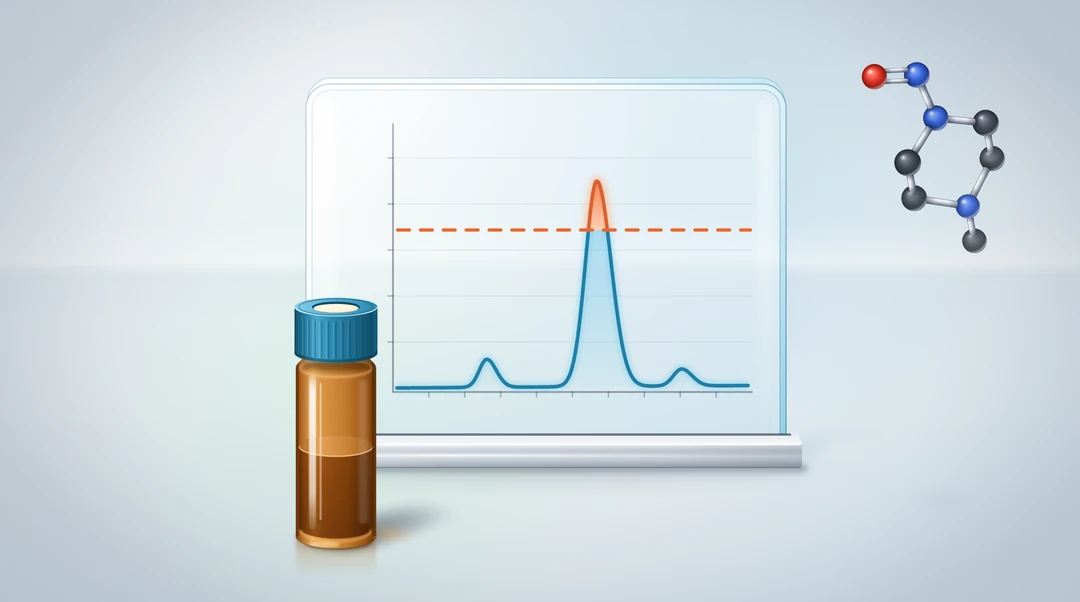
How an acceptable intake limit is derived for a nitrosamine drug substance-related impurity, how that limit becomes a parts-per-million specification, and what the regulatory options are when a confirmed result sits above it.
An acceptable intake limit for a nitrosamine impurity is the maximum daily exposure, expressed in nanograms per day, that a regulator considers to pose a negligible cancer risk. For a nitrosamine drug substance-related impurity with no carcinogenicity data of its own, the limit is predicted from chemical structure using the Carcinogenic Potency Categorisation Approach, which places the molecule in one of five potency categories, each carrying a fixed limit between 18 and 1500 ng/day.
Most teams arrive at this question the same way. A risk assessment flags a nitrosatable amine centre on the drug substance, nitrosamine impurity testing returns a figure, and that figure now has to be judged against a limit nobody has published for the molecule in front of them.
Key takeaways
- A nitrosamine acceptable intake (AI) limit is the daily exposure judged to carry a theoretical excess cancer risk of one additional case in 100,000 over a 70-year lifetime.
- Most nitrosamine drug substance-related impurities (NDSRIs) have no carcinogenicity data of their own, so the Carcinogenic Potency Categorisation Approach (CPCA) predicts a potency category from chemical structure alone and assigns the matching limit.
- There are five categories. The US FDA applies 26.5, 100, 400, 1500 and 1500 ng/day. The EMA applies 18 ng/day to Category 1 and agrees on the rest.
- The specification limit shall be defined by ppm = AI (ng/day) ÷ maximum daily dose (mg/day).
- Exceeding the limit does not automatically mean a recall. Four legitimate routes exist: compound-specific data or read-across, an enhanced Ames test, the less-than-lifetime adjustment FDA introduced on 24 September 2026, and a temporary interim limit where supply is at risk.
Three questions follow from there. Which category applies, and on what evidence. What the number becomes once it is written into a specification against a maximum daily dose. And what happens when a confirmed result sits above the limit, which is the point at which the programme stops being an analytical exercise and becomes a supply decision.
This guide works through all three, using the values published by the US Food and Drug Administration (FDA) and the European Medicines Agency (EMA) as they stand at the time of writing, and sets out what the differences between those two sets of values mean for a manufacturer in India supplying more than one market.
What an NDSRI is, and why its limit has to be predicted
Nitrosamine impurities fall into two structural classes. Small-molecule nitrosamines, such as N-nitrosodimethylamine (NDMA) and N-nitrosodiethylamine (NDEA), bear no structural relationship to the active pharmaceutical ingredient and turn up across many different products. Nitrosamine drug substance-related impurities (NDSRIs) are formed by nitrosation of the drug substance itself, at a secondary amine or a dimethyl tertiary amine centre, which makes each one effectively unique to its API.
That uniqueness is the entire problem. A small-molecule impurity studied for decades has rodent carcinogenicity data, and a limit can be calculated directly from it. A newly recognised NDSRI usually has none. There is no study to read, and commissioning a two-year carcinogenicity study is not a realistic response to a batch result.
At the same time, these impurities cannot simply be defaulted to the ordinary threshold of toxicological concern. ICH M7(R2) places N-nitroso compounds in the cohort of concern, a small group of high-potency mutagenic carcinogens for which the generic threshold is considered insufficiently protective. So the usual fallback is unavailable, and the data needed for a compound-specific answer does not exist.
This is why an NDSRI risk assessment runs ahead of any testing. It identifies the nitrosatable amine centres on the drug substance, the nitrite sources that could react with them, and therefore which impurities are credible enough to need a limit and a method at all. The limit question only arises for the structures that assessment flags.
The CPCA was built to close exactly that gap. Rather than measure potency, it predicts it from structure, so that a limit can be assigned to a molecule nobody has tested.
Where a nitrosamine acceptable intake limit comes from
Three routes produce an acceptable intake limit, and they sit in a clear order of preference. A limit from a higher route displaces one from a lower route.
- Compound-specific dataWhere robust rodent carcinogenicity data exists, the limit is calculated from the TD50, the dose producing tumours in half of the test animals. The TD50 in mg/kg/day is divided by 50,000 to move from a one-in-two tumour incidence to a one-in-100,000 excess cancer risk, then multiplied by a 50 kg body weight. This is how NDMA arrives at 96 ng/day and NDEA at 26.5 ng/day.
- Read-across from a surrogateWhere the nitrosamine itself is untested but a structurally and mechanistically similar compound is well characterised, the surrogate's potency can be used to derive a limit. The justification rests on the similarity argument, so the choice of surrogate is the part an assessor will examine.
- The Carcinogenic Potency Categorisation ApproachWhere neither of the above is available, which is the normal position for a new NDSRI, the CPCA assigns a predicted potency category from structure and the category carries the limit.
FDA maintains both outcomes publicly. Its table of CPCA-based limits held 285 entries when checked for this article, and a separate, much shorter table holds the limits derived from compound-specific data or read-across. An impurity can move between them: once real data appears, the predicted limit is superseded. So the first step in fixing an NDSRI acceptable intake limit is to check whether the regulator has already published one for that specific impurity, rather than scoring it from scratch.
Both FDA tables are revised continuously, and the figures quoted in secondary articles date quickly. Before fixing a limit in a specification, read the current entry on FDA's CDER nitrosamine acceptable intake limits page and the corresponding EMA appendix directly.
How the CPCA assigns a potency category
The CPCA is a rule-based structure-activity model. It rests on a single piece of mechanistic reasoning: a nitrosamine becomes genotoxic after metabolic activation by alpha-hydroxylation, so the structural features that make that pathway easier or harder are the features that drive potency.
The approach first asks whether the molecule can be activated at all. Three structural checks answer that. If neither alpha-carbon carries a hydrogen (N-nitroso-felodipine), if no alpha-carbon carries more than one (N-nitroso-enalapril), or if an alpha-carbon is tertiary, meaning an sp3 carbon bonded to three other carbons (N-nitroso-ketamine), activation is treated as blocked, and the nitrosamine goes straight to Category 5 without being scored.
Everything else is scored. A potency score is assembled from three components:
Potency Score = alpha-hydrogen score + deactivating feature score + activating feature score
Alpha-hydrogen score comes from the count of hydrogen atoms on each alpha-carbon, lowest count first. Fewer available alpha-hydrogens generally means a harder activation pathway.
Deactivating features add points, pushing the molecule towards a lower predicted potency and a higher limit. Examples include a carboxylic acid group anywhere on the molecule (+3), an N-nitroso group in a pyrrolidine ring (+3), an N-nitroso group in a five- or six-membered ring (+2), and a morpholine or seven-membered ring (+1).
Activating features subtract points. An aryl group bonded to an alpha-carbon scores −1, as does a methyl group bonded to a beta-carbon.
The total maps directly onto the category, and the category carries the limit. A lower score means a higher predicted potency and a tighter limit.
| Potency score | Category | Worked example from the EMA annex |
|---|---|---|
| 1 or less | Category 1 | N-nitroso-lorcaserin |
| 2 | Category 2 | N-nitroso-sertraline |
| 3 | Category 3 | N-nitroso-desloratadine |
| 4 or more | Category 4 | N-nitroso-l-nebivolol (score 4), N-nitroso-meropenem (score 10) |
| Not scored | Category 5 | N-nitroso-felodipine, N-nitroso-enalapril, N-nitroso-ketamine |
Scroll the table sideways on a narrow screen. Examples are taken from the worked calculations in the EMA's CPCA appendix.
Those eight molecules are worth keeping to hand. They are the only fully worked examples either regulator publishes, and they make it possible to sanity-check an in-house assignment against a position a regulator has already taken in writing.
An NDSRI with no published limit and no compound-specific or read-across data
Does a structural check block activation by alpha-hydroxylation?
Potency score = alpha-hydrogen score + deactivating feature score + activating feature score
- Alpha-hydrogen score from the count of hydrogens on each alpha-carbon
- Deactivating features add points and raise the limit
- Activating features subtract points and tighten it
The five CPCA categories and their nitrosamine limits
Four of the five categories carry identical limits on both sides of the Atlantic. Category 1 does not, and the difference matters to anyone filing in both markets.
| Category | US FDA limit | EMA limit | Basis for the figure |
|---|---|---|---|
| 1 | 26.5 ng/day | 18 ng/day | Highest predicted potency. FDA sets the limit at that of the most potent robustly tested nitrosamine; the EMA applies the class-specific threshold of toxicological concern for N-nitrosamines. |
| 2 | 100 ng/day | 100 ng/day | Representative of NDMA (96 ng/day) and NNK (100 ng/day). Potency predicted to be no higher than those two. |
| 3 | 400 ng/day | 400 ng/day | A four-fold reduction in predicted potency from Category 2, typically from a weakly deactivating feature. |
| 4 | 1500 ng/day | 1500 ng/day | Alpha-hydroxylation possible but disfavoured. Set at the ICH M7(R2) threshold of toxicological concern. |
| 5 | 1500 ng/day | 1500 ng/day | Not predicted to be activated by alpha-hydroxylation at all. Also set at the ICH M7(R2) threshold. |
Scroll sideways to see all columns.
FDA states the position plainly: for products intended for marketing in the United States it recommends 26.5 ng/day for Category 1 even where a different limit has been recommended elsewhere. A Category 1 NDSRI therefore has two correct limits at the same time, and a specification written for one market is not automatically defensible in the other.
A Category 1 assignment is the only point in the framework where the destination market changes the number. For a product filed in both the United States and the European Union, the EMA figure of 18 ng/day is the tighter of the two, and setting the analytical method's quantitation limit against it avoids having to revalidate later for a second market.
Turning an acceptable intake limit into a product specification
An acceptable intake limit is a daily exposure, but a specification is a concentration. The conversion is a single division against the maximum daily dose shown in the product labelling.
Limit in ppm = AI (ng/day) ÷ maximum daily dose (mg/day)
Worked example. A Category 2 NDSRI, limit 100 ng/day, in a product with a maximum daily dose of 200 mg. 100 ÷ 200 = 0.5 ppm, or 500 ppb.
Where the market matters. A Category 1 NDSRI in a 400 mg/day product. Against the FDA limit, 26.5 ÷ 400 = 0.066 ppm (66 ppb). Against the EMA limit, 18 ÷ 400 = 0.045 ppm (45 ppb).
Two points are routinely missed. First, the conversion is market-specific: the same NDSRI can carry different specifications in two different markets. Second, the maximum daily dose that applies is the one in the approved labelling, not the most common prescribed dose.
When more than one nitrosamine is present
Individual limits apply to individual impurities. Where a product contains more than one such impurity, whether NDSRIs, small-molecule nitrosamines or a combination, the total matters as well. If the combined level exceeds the acceptable intake limit of the most potent nitrosamine present, calculated against the maximum daily dose, the manufacturer should take the question to the regulator rather than resolve it internally. FDA directs applicants to raise a proposed total limit through the appropriate meeting or submission route.
Setting a specification is straightforward once the limit is settled. Demonstrating a method that can reliably quantify at that specification is the harder half, and it is where most deficiency letters land. Molkem Labs provides nitrosamine impurity testing with methods developed against the applicable limit rather than against a generic sensitivity target.
When the CPCA does not apply
The CPCA has a defined scope, and assignments made outside it will not hold. It applies to N-nitrosamines carrying a carbon atom on both sides of the N-nitroso group, where that carbon is not directly double bonded to a heteroatom. Several cases therefore fall outside it:
- N-nitrosamides, N-nitrosoureas and N-nitrosoguanidines, and other structures of the same type, sit outside the approach entirely.
- N-nitroso groups on a nitrogen within an aromatic ring, such as nitrosated indoles, are also outside it.
- Molecules carrying more than two N-nitroso groups are not covered; FDA directs manufacturers to contact the agency for guidance.
- Impurities already assigned a limit from compound-specific data or read-across should use that limit, not a predicted one.
Where a structure falls outside the scope, the limit has to be justified by another route, and an early conversation with the regulator is usually more efficient than building a position that will be rejected on scope grounds.
What to do when a result exceeds the acceptable intake limit
A confirmed result above the limit is a serious finding, and the first obligations are immediate. A drug product batch containing an NDSRI above the applicable limit should generally not be released for distribution, and product already in the market may warrant removal, because such product may be considered adulterated. Alongside that, the manufacturer should investigate the root cause and change the manufacturing process or the formulation to eliminate, reduce or mitigate the impurity, reporting the change to the approved application where one applies.
What that framing leaves out is that the limit itself is not always the right number. Four routes can legitimately change the position, and they are worth evaluating in parallel with remediation rather than after it.
| Route | What it does | What it requires |
|---|---|---|
| Compound-specific data or read-across | Replaces the predicted limit with one derived from real potency data, which is frequently higher. | Rodent carcinogenicity data, or a defensible surrogate argument based on structural and mechanistic similarity. |
| Enhanced Ames test | A negative result may support a limit higher than the predicted category limit. | Testing under the enhanced conditions FDA specifies, not a standard Ames assay. |
| Less-than-lifetime adjustment | Raises the limit where the product is not taken for a lifetime. The largest single lever available. | A treatment duration consistent with the approved labelling, and a submission to the agency. |
| Interim acceptable intake limit | A temporary higher limit allowing continued distribution where withdrawal would create a shortage. | Immediate contact with the regulator on supply risk. Granted case by case, for a defined period. |
Scroll sideways to see all columns.
The enhanced Ames test, and what sits behind it
The standard bacterial reverse mutation assay has reduced sensitivity for some of these compounds, so FDA recommends an enhanced version. The specified conditions include the full OECD 471 strain complement with Salmonella typhimurium TA98, TA100, TA1535 and TA1537 plus Escherichia coli WP2 uvrA (pKM101); the pre-incubation method with a 30-minute pre-incubation rather than plate incorporation; and testing both without a post-mitochondrial fraction and with 30 per cent rat and 30 per cent hamster liver S9 prepared from animals treated with cytochrome P450 inducers. A positive result from a standard Ames assay does not need repeating under enhanced conditions.
A negative enhanced Ames result is supportive rather than conclusive. FDA has indicated it is currently also requesting a second in vitro mammalian cell mutation assay together with in vitro metabolism data before accepting a limit of 1500 ng/day, and in vivo mutagenicity data where a limit above 1500 ng/day is sought.
Interim limits and the supply question
Where a manufacturing change or a recall is likely to disrupt supply, the shortage question is handled separately from the quality question and should be raised immediately rather than after remediation planning. FDA directs manufacturers to contact its Drug Shortage Staff directly, evaluates each case individually, and may recommend an interim limit for a temporary period, publishing it where more than one manufacturer is affected. Published interim limits have been set well above the corresponding predicted limits and carry an explicit review date, so they are a bridge to a permanent control strategy rather than a settlement.
The less-than-lifetime adjustment: the 2026 change
On 24 September 2026, FDA communicated that a less-than-lifetime adjustment may be appropriate for this class of impurity, adopting for this class the framework already described in ICH M7(R2). This reversed a long-standing position and is the most significant recent development in the area.
The logic is straightforward. Published acceptable intake limits assume daily exposure across a 70-year lifetime. A medicine taken for two weeks does not deliver that cumulative dose, so the limit can be raised by a factor that keeps the total lifetime exposure within the same one-in-100,000 risk estimate.
| Duration of treatment | Adjustment factor | Category 2 limit becomes |
|---|---|---|
| Up to 1 month | 80 × | 8,000 ng/day |
| More than 1 month to 12 months | 13.3 × | 1,330 ng/day |
| More than 1 year to 10 years | 6.67 × | 667 ng/day |
| More than 10 years to lifetime | No adjustment | 100 ng/day |
Scroll sideways to see all columns. The third column is illustrative, applying each factor to the 100 ng/day Category 2 limit.
The treatment duration must be consistent with the approved labelling and dosing regimen, not with how the product is typically used. The adjustment is not recommended for interim acceptable intake limits. And it is not automatic: a scientific justification and the proposed indicated population have to be submitted, with the request identified as an LTL request, generally through a prior approval supplement for an approved product.
For short-course products in particular, antibiotics, antifungals and acute-care medicines among them, this adjustment can move a failing result into compliance without any change to the process or the formulation. It should be the first calculation performed after a confirmed exceedance, because it may remove the need for the other three routes entirely.
What this means for manufacturers in India
Indian pharmaceutical and generic manufacturers face this framework from an unusual position, because most are supplying the domestic market and one or more regulated export markets from the same site and frequently from the same batch record.
Indian Pharmacopoeia 2022 introduced General Chapter 5.11 on nitrosamine impurities, effective from December 2022, giving a domestic reference point alongside the ICH, FDA and EMA frameworks. In August 2026 the Indian Pharmacopoeia Commission released seven Indian Pharmacopoeia Nitrosamine Impurities Reference Standards, covering the compounds most often named in risk evaluations. Those standards materially reduce the cost and lead time of qualifying a method domestically, although NDSRIs remain product-specific and sit outside any fixed set.
Four consequences follow for a programme run from India:
Where a Category 1 NDSRI is in scope, EMA's 18 ng/day is tighter than FDA's 26.5 ng/day. Developing the method against the lower figure avoids a second validation exercise later.
A single impurity programme has to satisfy the US FDA, the EMA, the Central Drugs Standard Control Organisation (CDSCO) and the other authorities a product is filed with, each of which may hold a different view of the same impurity.
FDA's recommended date for concluding NDSRI confirmatory testing and submitting required changes was 1 August 2025. Where that was not achievable, a progress update was expected instead, so an incomplete programme is now visible to the agency.
The Indian Pharmacopoeia reference standards cover the common small-molecule nitrosamines. An NDSRI standard still has to be synthesised or sourced specifically, which is usually the long pole in method development.
On the deadline point, FDA acknowledged in June 2025 that the August 2025 date was not achievable for every approved application and set out what a progress update should contain instead: whether NDSRIs can form under targeted forced degradation, which were detected, the validated test method, the batches analysed, the confirmatory results in ng/day or ppm, the root cause where known, the mitigation attempted and an estimated completion date. For application holders this belongs in the Log of Outstanding Regulatory Business in the Annual Report. Manufacturers of non-application products, which do not file annual reports, should prepare the same information and retain it for inspection.
What the submission has to show
Whichever route produces the limit, an assessor is reading for a consistent chain of reasoning rather than a single number. A complete position generally contains the following.
- The nitrosamine risk assessment, identifying the nitrosatable amine centres in the drug substance and the nitrite sources in the excipients, water and packaging, with the reasoning for each conclusion recorded rather than summarised.
- The limit and its derivation, stating the route used, and for a CPCA assignment the structural features scored and the resulting category, in a form an assessor can reproduce.
- The conversion to a specification, showing the maximum daily dose used and the resulting ppm or ppb figure.
- The analytical method and its validation, demonstrating quantitation at a level appropriate to the specification, in the actual product matrix rather than in solvent.
- Confirmatory results on representative batches, with the date of analysis relative to the date of manufacture, since NDSRI levels can change on storage.
- The control strategy, covering root cause, the mitigation applied and the ongoing controls, including excipient nitrite specifications where those are the source.
Where a limit has been raised by read-across, an enhanced Ames result or a less-than-lifetime adjustment, the supporting justification travels with it, and the labelling-based treatment duration becomes part of the quality argument rather than a clinical detail.
Frequently asked questions
What is the acceptable intake limit for a nitrosamine impurity?
It is the maximum daily intake, in nanograms per day, associated with a theoretical excess cancer risk of one additional case in 100,000 people assuming daily exposure over a 70-year lifetime. An NDSRI acceptable intake limit assigned by the Carcinogenic Potency Categorisation Approach is 26.5, 100, 400 or 1500 ng/day under the US FDA, and 18, 100, 400 or 1500 ng/day under the EMA.
How do I convert ng/day to ppm?
Divide the acceptable intake limit in nanograms per day by the maximum daily dose of the product in milligrams per day. A limit of 100 ng/day in a product with a maximum daily dose of 200 mg gives 0.5 ppm, or 500 ppb. The result depends on the maximum daily dose in the approved labelling, and it can differ between markets, because FDA and EMA set different Category 1 limits.
How do you calculate a nitrosamine limit when there is no carcinogenicity data?
Use the Carcinogenic Potency Categorisation Approach. Establish first whether the molecule can be metabolically activated by alpha-hydroxylation; if neither alpha-carbon carries a hydrogen, if no alpha-carbon carries more than one, or if an alpha-carbon is tertiary, it cannot, and it is Category 5 at 1500 ng/day. Otherwise calculate a potency score as the sum of the alpha-hydrogen score, the deactivating feature scores and the activating feature scores. A score of 1 or less gives Category 1, 2 gives Category 2, 3 gives Category 3, and 4 or more gives Category 4.
What is the ICH guideline for nitrosamines?
ICH M7(R2), on the assessment and control of DNA reactive (mutagenic) impurities, published in July 2023. It places N-nitroso compounds in the cohort of concern, meaning the ordinary threshold of toxicological concern is not considered sufficiently protective for them, and it provides the less-than-lifetime framework that FDA adopted for nitrosamines in September 2026. The CPCA complements ICH M7(R2) rather than replacing it.
What are the 7 nitrosamine impurities?
The seven most frequently named N-nitrosamines are NDMA, NDEA, NEIPA, NDBA, NMPA, NDIPA and NMBA. These are the seven for which the Indian Pharmacopoeia Commission released reference standards in August 2026. They are small-molecule nitrosamines and not an exhaustive list; NDSRIs are specific to individual drug substances and fall outside any fixed set of seven. The nitrosamine impurity testing page sets out each one with its current recommended limit.
Does exceeding the acceptable intake limit mean a recall?
Not necessarily, although a batch above the applicable limit should generally not be released and marketed product may warrant removal. Four routes can change the position: compound-specific data or read-across, a negative enhanced Ames test, a less-than-lifetime adjustment where the product is not taken for a lifetime, and an interim limit where withdrawal would create a supply shortage. Where supply is at risk, the regulator should be contacted immediately rather than after remediation is planned.
What is the less-than-lifetime adjustment for nitrosamines?
An adjustment that raises a lifetime acceptable intake limit for products not taken across a lifetime. FDA communicated it for nitrosamine impurities on 24 September 2026. The factors are 80 times the lifetime limit for treatment up to one month, 13.3 times for more than one month to twelve months, 6.67 times for more than one year to ten years, and no adjustment beyond ten years. It does not apply to interim limits, and it has to be requested with a scientific justification.
Why do FDA and EMA give different limits for the same impurity?
They differ only in Category 1. The EMA applies 18 ng/day, the class-specific threshold of toxicological concern for N-nitrosamines. FDA applies 26.5 ng/day, the limit of the most potent robustly tested compound in the class, and states that this figure should be used for products marketed in the United States even where another authority recommends a different one. Categories 2 to 5 are identical.
Does the CPCA apply to every nitrosamine?
No. It applies to N-nitrosamines with a carbon atom on both sides of the N-nitroso group where that carbon is not directly double bonded to a heteroatom. N-nitrosamides, N-nitrosoureas, N-nitrosoguanidines and related structures are excluded, as are N-nitroso groups within an aromatic ring such as nitrosated indoles, and molecules with more than two N-nitroso groups require a direct discussion with the agency. Where compound-specific data or a read-across limit already exists, that limit applies instead of a predicted one.
What happens when a product contains more than one nitrosamine?
Each impurity is assessed against its own limit, and the combined level is assessed as well. Where the total exceeds the acceptable intake limit of the most potent nitrosamine present, calculated against the maximum daily dose, the position should be discussed with the regulator, and a total nitrosamine limit proposed through the appropriate submission route.
Discuss an NDSRI result with an analytical team
Molkem Labs supports nitrosamine programmes from risk evaluation through method development and validation to confirmatory quantification and control strategy, for products filed with the US FDA, the EMA, CDSCO and other regulated markets. If confirmatory testing has returned a result you need to interpret, a technical discussion is the quickest way to establish which of the available routes applies to your product.
This article was prepared by the Molkem Labs analytical research and development team. Regulatory positions described here are drawn from the published guidance of the US FDA, the European Medicines Agency and ICH M7(R2), and reflect those sources as published. Acceptable intake values are revised periodically and should be confirmed against the live regulator tables before use.
Related reading: nitrosamine impurity testing · analytical research and development · regulatory services · regulatory affairs in drug development