Global - English
 Brazil - Portuguese
 Thailand - Thai
 Middle East - Arabic
 Vietnam - Vietnamese
 Spain - Spanish
 Colombia - Spanish
 Argentina - Spanish


What separates a ready-to-use sterile solution from a freeze-dried product, which molecule and programme facts decide between them, and what the choice commits you to in sterilization and reconstitution.
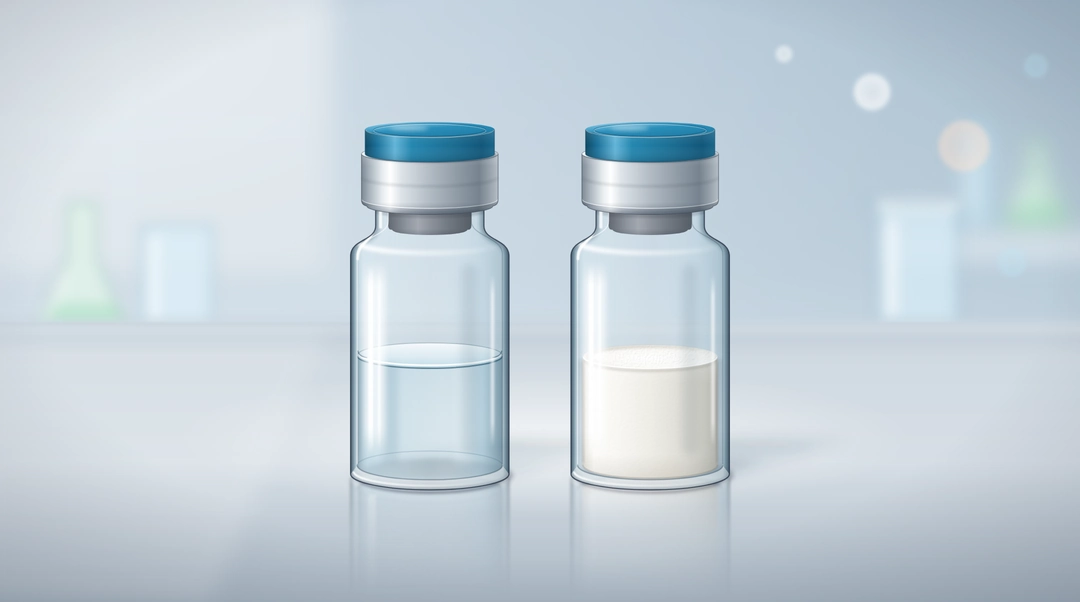
A liquid injectable is a sterile solution filled into its final container and injected as supplied. A lyophilized injectable is that same solution freeze-dried into a dry solid cake, sealed, and reconstituted with a diluent before use. The choice between them is decided by one question above all others: whether the molecule stays within specification in water for the shelf life the market requires. When it does, a liquid is almost always the better product. When it does not, lyophilization is the standard remedy, and it is paid for in manufacturing cost, cycle time and an extra step at the bedside.
Most teams reach this decision at the same moment. Early solution-stability data comes back, the degradation rate is higher than the target shelf life allows, and a presentation has to be fixed before injectable formulation development can move forward. Choosing wrongly at this point is expensive, because the format determines the container, the sterilization route, the stability programme and the manufacturing line for the rest of the product's life.
Key takeaways
- The decision is driven by stability, not preference. A liquid is simpler, cheaper and safer to administer, so it is the default unless the molecule cannot hold up in water.
- Lyophilization removes the water that drives hydrolysis, aggregation and most chemical degradation, which is why peptides, proteins, many beta-lactam antibiotics and several oncology products are supplied as freeze-dried powders.
- Choosing lyophilization also chooses aseptic processing. A freeze-dried cake cannot practically be terminally sterilized.
- Stability conditions shall be followed as defined in the ICH guideline for parenteral formulations.
- Reconstitution is not only a convenience question. It is a set of regulatory deliverables: reconstitution time, diluent compatibility, in-use stability and a defined hold time.
This guide sets out the comparison first, then the five factors that settle the injectable dosage form in practice, then the two consequences that comparison articles usually leave out: the sterilization route and what reconstitution obliges you to prove.
Liquid vs lyophilized injectables at a glance
A lyophilized versus liquid formulation comparison comes down to a small set of attributes: physical state, preparation before use, stability, storage, manufacturing and cost. The table below sets out each one side by side.
| Attribute | Liquid injectable | Lyophilized injectable |
|---|---|---|
| Physical state | Sterile solution in a vial, ampoule or prefilled syringe | Dry porous cake or powder under vacuum or inert gas |
| Preparation before use | None, or dilution into an infusion bag | Reconstitution with a specified volume of a specified diluent |
| Main stability risk | Hydrolysis, oxidation, aggregation and particle formation continue throughout shelf life | Residual moisture, cake collapse and stress during the freezing step |
| Typical shelf life | Shorter, and frequently refrigerated | Longer, and often achievable at controlled room temperature |
| Distribution | Commonly cold chain dependent | Less cold chain dependent, and more tolerant of transport stress |
| Sterilization route | Terminal sterilization is possible for heat-stable products | Aseptic processing in practice |
| Manufacturing | Compound, filter, fill, seal | Compound, filter, fill, freeze-dry over a cycle measured in days, stopper, seal |
| Cost and capacity | Lower unit cost and higher line throughput | Higher unit cost, high capital requirement and freeze-dryer capacity as the constraint |
| Risk at point of use | Low, because no preparation step is required | Reconstitution error, incomplete dissolution, particulates and a limited hold time |
Swipe horizontally to see the full table on a small screen.
What each format actually is
Liquid injectables
A liquid injectable is a sterile aqueous solution of the drug substance with the excipients needed to hold pH, tonicity and stability. It is compounded, filtered through a sterilizing-grade filter, filled and sealed. Nothing further happens to it before it reaches the patient, which is the format's central advantage. There is no preparation step, so there is no preparation error, and manufacturing is a comparatively short and well-understood sequence.
The liability of this formulation strategy is that the active pharmaceutical ingredient (API) resides in an aqueous environment throughout its assigned shelf life, where water acts as a direct reactant in solvolytic/hydrolytic cleavage and facilitates mass transfer of dissolved molecular oxygen and mobile excipients to the labile sites. For low-molecular-weight, chemically resilient small molecules, this impact is negligible, whereas for high-molecular-weight peptides or proteins, it can compromise critical quality attributes and dictate product viability.
Lyophilized injectables
A lyophilized injectable starts as the same solution. It is filled into vials, then freeze-dried in three stages. Freezing solidifies the water into ice and fixes the structure of the cake. Primary drying removes that ice by sublimation under vacuum, turning it straight from solid to vapour without passing through a liquid phase. Secondary drying then removes the water that remains bound to the solid, bringing residual moisture down to the level the product needs. The vials are stoppered inside the chamber and sealed.
What remains is a dry cake in which the degradation pathways that need water are largely shut down. The product is reconstituted with a diluent immediately before administration, which returns it to a solution with the same composition it started with.
The term is used interchangeably with freeze-drying. A lyophilized injection and a freeze-dried injection are the same thing.
Five factors that decide the format
In practice the format is settled by five factors, assessed in this order. The first carries the most weight, and in many programmes it decides the matter on its own. The remaining four either confirm that answer or override it for regulatory or commercial reasons.
-
Solution stability against the required shelf life
This is the test the format exists to answer. If accelerated and long-term solution data project a shelf life shorter than the commercial target, a liquid is not viable and lyophilization becomes the remedy.
Evidence needed: forced degradation under acidic, basic, oxidative, thermal, hydrolytic and photolytic stress; a stability-indicating analytical method; solution stability at the proposed storage condition; for biological products, the aggregation and subvisible particle profile.
-
The intended storage condition
Shelf life is not an absolute property. It is measured against the storage condition the product will carry on its label, and the stability programme follows the ICH guideline conditions for that storage. The same stability data can support a liquid stored refrigerated and not one stored at room temperature.
Evidence needed: the intended storage condition and labelling, and long-term and accelerated data at the matching ICH conditions.
-
The sterilization route the product can take
Regulators expect terminal sterilization wherever the product can withstand it. A lyophilized product cannot practically be terminally sterilized, so choosing that format commits the programme to aseptic processing and to the controls that come with it.
Evidence needed: heat and radiation stability of the drug substance and the finished product, and a documented justification following the EMA sterilisation decision trees.
-
The setting in which the product is administered
Reconstitution is acceptable in a hospital pharmacy with trained staff. It is a much larger obstacle for a product intended for a clinic, a community setting or self-administration, where a ready-to-use presentation reduces preparation error and supports adherence.
Evidence needed: the intended care setting, the dose volume, whether a device or prefilled syringe is planned, and the reconstitution time a user can reasonably be asked to wait.
-
The cost in capital, capacity and time
A lyophilization cycle occupies a freeze-dryer for days rather than hours, and freeze-dryer capacity is usually the constraint on how much product a site can release. That shapes cost of goods, batch scheduling and the choice of manufacturing partner.
Evidence needed: the projected annual volume, available freeze-dryer capacity at the intended site or partner, and a realistic cycle development and scale-up timeline.
If the molecule is stable in water at its intended storage condition for the shelf life you need, build a liquid. If it is not, and reformulation cannot close the gap, lyophilize. Factors three to five rarely reverse a clear answer to the first, but they frequently decide a borderline case.
The sterilization route most comparisons leave out
The third factor deserves a section of its own, because it is the consequence most comparison articles omit entirely, and it reaches further into the programme than the format decision itself.
Regulators do not treat sterilization methods as equivalent. The EMA guideline on the sterilisation of the medicinal product, active substance, excipient and primary container sets out decision trees that begin with terminal sterilization in the final container and treat aseptic processing as the option of last resort, acceptable only where terminal sterilization is shown to be unsuitable. For heat-labile substances such as proteins, a scientific justification for aseptic processing is generally accepted, but the justification still has to be made.
India takes the same position in statute rather than guidance. The revised Schedule M to the Drugs and Cosmetics Rules, notified as G.S.R. 922(E) on 28 December 2023, covers sterile products in Part II and requires terminal sterilization by heat in the final container wherever that is possible. A lyophilized product cannot meet that expectation. The cake is dried precisely to remove water, and moist-heat sterilization of the sealed vial would reintroduce it and destroy the cake structure.
The practical consequence is that choosing lyophilization commits the product to aseptic processing, and therefore to the full weight of EU GMP Annex 1 and Schedule M Part II: a contamination control strategy, Grade A conditions for the open product right through loading of the freeze-dryer, media fills that simulate the lyophilization step including partial stoppering and chamber transfer, and environmental monitoring across a far longer exposure window than a straightforward fill-and-seal line presents.
Teams that treat sterilization as a downstream manufacturing question discover it after the format is fixed. It is cheaper to establish during development that the molecule cannot take terminal sterilization than to justify aseptic processing to an assessor after the fact, and the same data answers both questions.
What a lyophilized programme costs in time and capacity
The advantages of lyophilization are well covered elsewhere. Its costs are less often set out plainly, and they fall into four areas.
The freezing, primary drying and secondary drying profile has to be developed for the specific formulation, with the critical temperatures of the product established first. This is a development activity in its own right, not a setting that transfers from another product.
A cycle occupies the freeze-dryer for days rather than hours, so batch throughput falls sharply against a comparable liquid line.
Freeze-dryers are costly, and capacity is usually the binding constraint on annual output. It also narrows the list of manufacturing partners that can take the product.
Residual moisture, cake appearance, reconstitution time and reconstituted solution quality all become specification items that a liquid product never has to control.
There is also a scale-up risk that is specific to this format. A cycle developed on a laboratory freeze-dryer does not transfer directly to a production unit, because heat transfer, chamber geometry and condenser capacity all differ. Building the cycle with scale-up in mind, and confirming it at the intended manufacturing scale, is a normal part of technology transfer for a freeze-dried product. Development and commercial-scale manufacturing can be supported by qualified CDMO/CMO partners.
Reconstitution: what regulators expect you to show
Reconstitution is usually described as an inconvenience. It is more accurate to describe it as a set of deliverables that a liquid product simply does not generate.
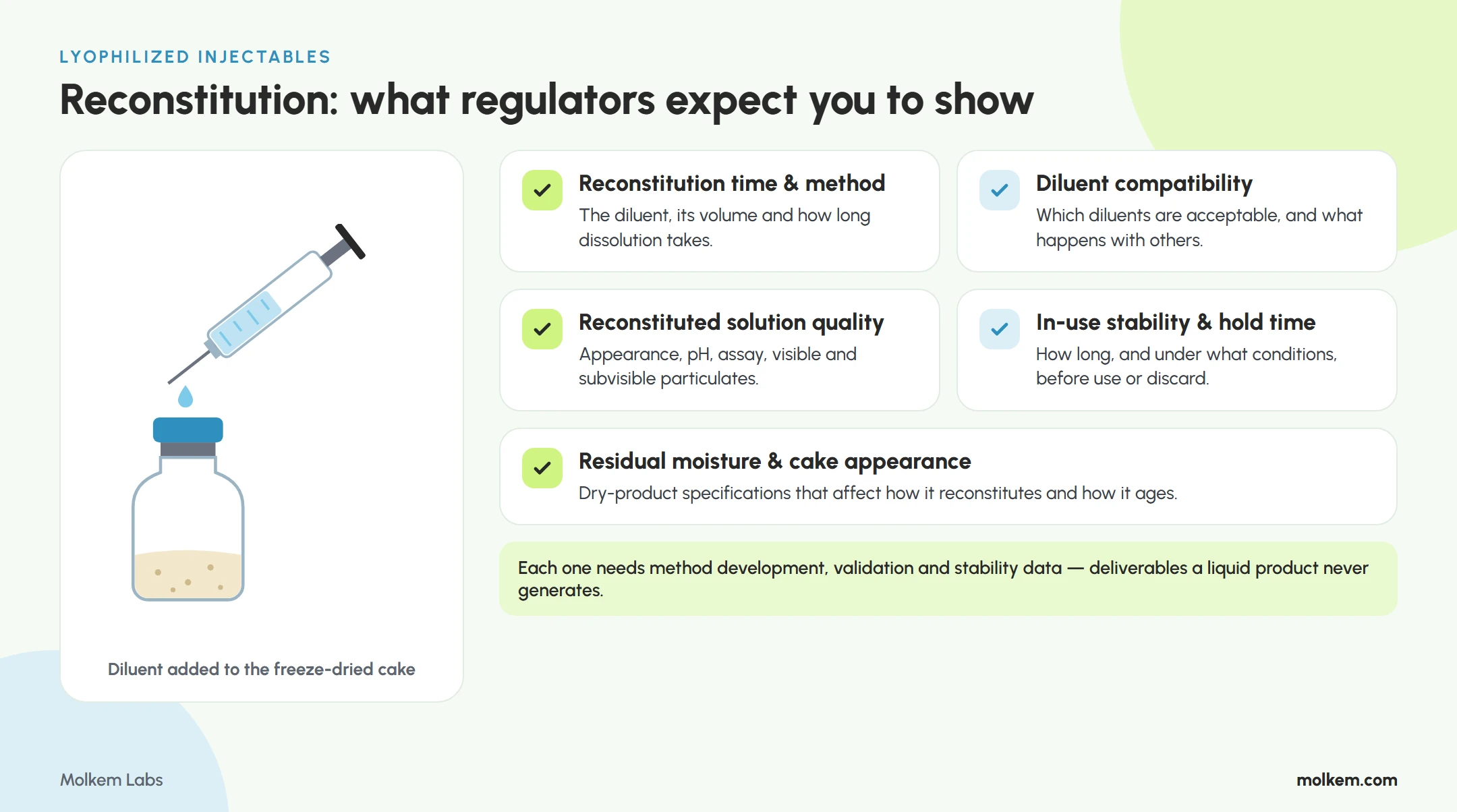
- Reconstitution time and method. The diluent, its volume, and how long dissolution takes. High-concentration protein products can take several minutes, which is a genuine obstacle at the point of care.
- Diluent compatibility. Which diluents are acceptable, and what happens with the ones a clinician is likely to reach for instead.
- Reconstituted solution quality. Appearance, pH, assay, and subvisible and visible particulates after reconstitution, not only in the dry cake.
- In-use stability and hold time. How long the reconstituted solution may be held, and under what conditions, before it must be used or discarded. The EMA note for guidance on in-use stability testing of human medicinal products sets the expectations most authorities follow.
- Residual moisture and cake appearance. Specification items for the dry product that directly affect how it reconstitutes and how it ages.
Each of these needs method development, validation and stability data. They are a real part of the cost of the format, and they are the items most often underestimated when a programme switches from liquid to lyophilized late in development.
Four mistakes that make this decision harder than it needs to be
- Choosing the format before the stability data exists. The decision rests on the first factor, and that factor cannot be settled without forced degradation and solution stability data from a stability-indicating method. Committing earlier is guesswork.
- Treating lyophilization as a universal fix. Freeze-drying addresses degradation that depends on water. It does not rescue a molecule that is unstable for other reasons, and the freezing step itself stresses proteins. Some molecules degrade during the cycle.
- Testing at the wrong storage condition. Shelf life is assigned for the storage condition the label will state, and long-term data generated at a milder condition does not support it. Discovering the gap late is a common cause of a format being reversed.
- Leaving the sterilization justification until the dossier. The route follows from the format, and assessors expect a documented rationale. Generating it during preformulation development, when the heat-stability data is being produced anyway, costs very little.
Deciding the format for your molecule
Molkem Labs supports liquid injectable programmes from early solution-stability work through formulation, analytical method development, stability studies under ICH conditions and technology transfer. If you are weighing a liquid against a lyophilized presentation, a consultation can establish what your existing data already settles and what still needs to be generated.
Frequently asked questions
What is a lyophilized injection?
A lyophilized injection is a sterile product that was filled as a solution and then freeze-dried into a dry cake inside its final container. It is reconstituted with a specified diluent immediately before administration. Freeze-drying removes the water that drives most degradation, which is why the format is used for molecules that cannot hold up as a liquid for a commercial shelf life.
What are the disadvantages of lyophilization?
There are five main ones. The manufacturing cycle takes days rather than hours, so throughput is much lower. Freeze-dryers are expensive and their capacity usually limits output. The cycle has to be developed for each formulation and does not transfer directly from laboratory to production scale. Reconstitution introduces preparation error and a limited hold time at the point of use. And the format adds specification items, including residual moisture, cake appearance and reconstitution time, that a liquid product never has to control.
What is the difference between lyophilized and non-lyophilized products?
A non-lyophilized injectable is supplied as a liquid and used as supplied. A lyophilized product is supplied dry and has to be reconstituted first. The practical differences follow from that: the lyophilized form generally has a longer shelf life and is less dependent on cold chain, while the liquid form is cheaper to make, faster to manufacture and carries no preparation step for the person administering it.
What are the three stages of lyophilization?
Freezing, primary drying and secondary drying. Freezing solidifies the water and fixes the structure of the cake. Primary drying removes that ice by sublimation under vacuum, so it passes directly from solid to vapour. Secondary drying then removes the water still bound to the solid, bringing residual moisture down to the target level. The vials are stoppered inside the chamber before the cycle ends.
Why are some drugs lyophilized and others not?
Because only some molecules need it. Water is directly involved in hydrolysis and gives dissolved oxygen access to the molecule, so a drug that degrades through those pathways may not survive as a solution for long enough to be commercially viable. Removing the water largely shuts those pathways down. A molecule that is stable in water gains nothing from freeze-drying and would only inherit its cost and its reconstitution step.
What drugs are lyophilized?
Typically peptides and proteins, monoclonal antibodies and other biological products, many beta-lactam antibiotics including several cephalosporins and carbapenems, a number of oncology products, and some vaccines. The common thread is a molecule that loses potency or forms degradants or aggregates in solution faster than the target shelf life allows.
Is a lyophilized injection better than a liquid injection?
Neither dosage form is better in general terms. A liquid is simpler, cheaper, faster to manufacture and safer to administer, so it is the preferred option whenever the molecule allows it. A lyophilized product is better only where the molecule cannot support a liquid shelf life, or where removing cold chain dependency carries enough commercial value to justify the added cost.
Can a lyophilized product be terminally sterilized?
In practice, no. Moist-heat sterilization of a sealed vial would reintroduce the water the cycle was run to remove and would destroy the cake structure, and most lyophilized molecules are heat-labile in any case. Lyophilized products are therefore filled aseptically and freeze-dried under aseptic conditions. Because regulators expect terminal sterilization wherever it is possible, the dossier needs a documented justification for the aseptic route.
Can a liquid injectable be converted to a lyophilized form later in development?
It can, but it is not a simple substitution. The formulation usually has to change, because a lyophilized product needs bulking agents and cryoprotectants or lyoprotectants that a liquid does not. A cycle has to be developed, the stability programme restarts, and reconstitution data has to be generated. Deciding the format on early stability data is considerably cheaper than reversing it later.
Sources referenced
- EMA, Guideline on the sterilisation of the medicinal product, active substance, excipient and primary container
- European Commission, EU GMP Annex 1, Manufacture of Sterile Medicinal Products
- ICH Q1A(R2), Stability Testing of New Drug Substances and Products
- EMA, Note for Guidance on In-Use Stability Testing of Human Medicinal Products
- Central Drugs Standard Control Organisation (CDSCO), India, for the Drugs and Cosmetics Rules and the revised Schedule M