Global - English
 Brazil - Portuguese
 Thailand - Thai
 Middle East - Arabic
 Vietnam - Vietnamese
 Spain - Spanish
 Colombia - Spanish
 Argentina - Spanish


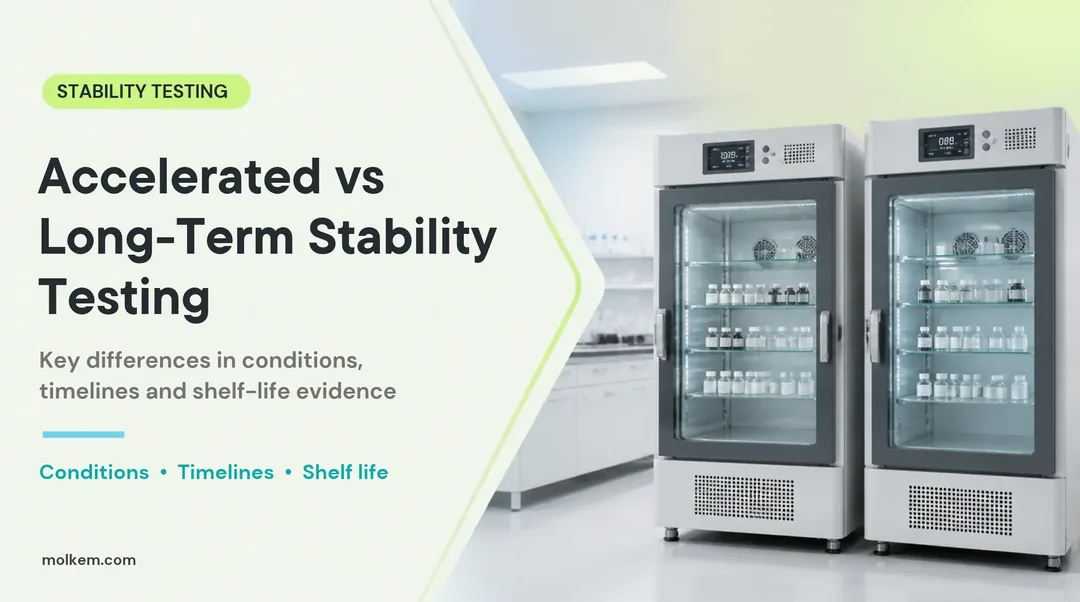
What each study measures, the conditions and timelines set by ICH and by India's rules, how accelerated results decide how far long-term data can be stretched, and the misconceptions that still appear in filings.
Accelerated stability testing stores a product under stress, usually 40 °C and 75% relative humidity for six months, to show early how it degrades. Long-term stability testing stores it under the intended storage condition for the full shelf life, to prove how long it stays within specification. Accelerated data predicts and supports. Long-term data decides the shelf life.
Both studies run side by side on the same batches from the first day. They are not alternatives. The real question in accelerated vs long-term stability testing is how the two data sets work together, and what each one allows you to claim in a dossier. This guide sets that out for regulatory, CMC (chemistry, manufacturing and controls) and quality teams, using the ICH guidelines and India's New Drugs and Clinical Trials Rules, 2019. Molkem Labs runs both study types as part of its analytical and microbiological services and its stability testing programmes.
At a Glance
Accelerated testing runs at 40 °C / 75% RH for at least 6 months. It shows degradation early, supports limited extrapolation, and helps assess short trips outside the label condition, such as during shipping.
Long-term testing runs at the label storage condition through the whole proposed shelf life. ICH asks for at least 12 months of data at submission. It is the only basis for the shelf life.
Both use the same three primary batches. Accelerated testing is not a one-batch screening study.
Six months accelerated does not equal two years of shelf life. Under ICH Q1E, a clean accelerated result lets you extrapolate long-term data to at most twice its length, and never more than 12 months beyond it.
India sets its own rule. For new drugs, long-term testing runs at 30 °C / 75% RH, and the minimum long-term data at submission is 6 or 12 months depending on the accelerated result.
Accelerated vs long-term stability testing compared
The difference between accelerated and long-term stability studies comes down to purpose, storage condition, duration and the weight each carries with an assessor. The table sets out each attribute side by side. It follows the general case in ICH Q1A(R2), which covers most solid and liquid products stored at room temperature.
Swipe horizontally to see the full table on a small screen.
| Attribute | Accelerated study | Long-term study |
|---|---|---|
| Main purpose | Speed up degradation to reveal risks early and support limited extrapolation | Show real behavior at the label condition and set the shelf life or retest period |
| Storage condition | 40 °C ± 2 °C / 75% RH ± 5% RH | 25 °C / 60% RH or 30 °C / 65% RH under ICH; 30 °C / 75% RH in India |
| Minimum data at submission | 6 months | 12 months under ICH; 6 or 12 months under India's rules |
| Typical test points | 0, 3 and 6 months | Every 3 months in year one, every 6 months in year two, then once a year |
| Batches | At least three primary batches | The same three primary batches |
| Nature of the data | Predictive and supportive | Observed and decisive |
| Can it set the shelf life alone | No | Yes, with limited extrapolation where justified |
| After approval | 6 months on each commitment batch | Continued through the full proposed shelf life |
A primary batch is a batch used in the formal stability study that supports the filing. Under ICH Q1A(R2), two of the three must be at least pilot scale, and all three must be packed in the container proposed for marketing.
What accelerated stability testing is
ICH defines accelerated testing as studies that increase the rate of chemical or physical change by using exaggerated storage conditions, as part of the formal stability programme. In plain terms, you make the product age faster so that problems show up in months rather than years.
The science behind it is simple. Most chemical reactions run faster when it is hotter. Many also run faster when there is more moisture. Raising the temperature to 40 °C and the humidity to 75% relative humidity (RH, the amount of moisture in the air compared with the most it can hold) speeds up hydrolysis, oxidation and other common degradation routes.
The study gives three useful outputs:
- An early warning. If impurities rise or assay falls at 40 °C, the team learns about it in three months rather than after a year on the shelf.
- A gate for extrapolation. A clean accelerated result is one of the conditions that allows a shelf life slightly longer than the long-term data already covers.
- Evidence on excursions. ICH notes that accelerated data can be used to judge the effect of short periods outside the label condition, such as a hot truck during transport.
Accelerated testing is different from stress testing, also called forced degradation. Stress testing pushes a single batch much harder, for example in 10 °C steps above the accelerated condition, with acid, base, oxidation and light. Its job is to find the likely degradation products and prove the analytical method can see them. That work normally happens earlier, during preformulation development, and it is what makes the method used in both formal studies stability-indicating.
What long-term (real-time) stability testing is
Long-term testing stores the product under the storage condition recommended on its label, for the shelf life or retest period being proposed. It is also called real-time stability testing, because the product ages at its normal rate. The two names describe the same study.
This study is the evidence that sets the shelf life (the period a finished product stays within specification) or the retest period (the period after which a drug substance must be retested before use). Samples are pulled at fixed time points and tested for the attributes most likely to change, such as assay, degradation products, dissolution, water content, appearance and, where relevant, microbial quality and preservative content.
Because the study must cover the whole shelf life, it usually runs for 24 to 36 months or more. It continues after approval. ICH Q1A(R2) requires at least 12 months of long-term data on three primary batches at the time of submission, and a commitment to keep testing until the proposed shelf life is fully covered.
Every result in both studies depends on the analytical method. A method that cannot separate a degradant from the main peak will hide exactly the change the study exists to find. This is why stability-indicating method development and validation comes before the first sample goes into a chamber.
Storage conditions for each study type
The accelerated stability study conditions and long-term conditions depend on how the product will be stored. The table below summarizes the drug product conditions in ICH Q1A(R2). Drug substances follow the same pattern for the general, refrigerated and freezer cases.
Swipe horizontally to see the full table on a small screen.
| Intended storage | Long-term | Intermediate | Accelerated |
|---|---|---|---|
| General case (room temperature) | 25 °C / 60% RH or 30 °C / 65% RH, 12 months | 30 °C / 65% RH, 6 months, only when long-term is 25 °C / 60% RH | 40 °C / 75% RH, 6 months |
| Semi-permeable containers | 25 °C / 40% RH or 30 °C / 35% RH, 12 months | 30 °C / 65% RH, 6 months | 40 °C / not more than 25% RH, 6 months |
| Refrigerator | 5 °C ± 3 °C, 12 months | Not applicable | 25 °C / 60% RH, 6 months |
| Freezer | −20 °C ± 5 °C, 12 months | Not applicable | No accelerated condition. One batch is tested at a higher temperature to cover excursions |
Two points in this table are often missed. First, the accelerated condition for a refrigerated product is 25 °C / 60% RH, not 40 °C / 75% RH. Second, a frozen product has no accelerated study at all, so its shelf life rests entirely on real-time data. The months shown are the minimum data needed at submission, not the full length of each study.
Significant change and intermediate stability testing
The link between the two studies is a defined term: significant change. For a drug substance, significant change means failure to meet its specification. For a drug product, ICH Q1A(R2) lists five types:
- a 5% change in assay from the initial value, or failure to meet potency criteria for biological products;
- any degradation product exceeding its acceptance criterion;
- failure to meet criteria for appearance, physical attributes or functionality, such as color, phase separation, caking, hardness or dose delivery;
- failure to meet the pH acceptance criterion, where relevant;
- failure to meet the dissolution criteria for 12 dosage units, where relevant.
Some physical changes are expected at 40 °C / 75% RH and do not count on their own. ICH Q1E names the softening of a suppository designed to melt at body temperature, and dissolution failure in gelatin capsules that is clearly caused by cross-linking. Phase separation of a semi-solid, however, still calls for intermediate testing.
What happens next follows a fixed order. This is the decision sequence that connects the accelerated result to the long-term claim:
Start both studies together
Place the three primary batches on long-term and accelerated storage at time zero. Many teams also place samples at the intermediate condition at the start, so data is ready if it is needed.
Review the accelerated results at 3 and 6 months
Compare every attribute against the significant change criteria above.
No significant change: extrapolation is possible
The accelerated data supports a shelf life somewhat beyond the long-term data, within the limits set by ICH Q1E.
Significant change with long-term at 25 °C / 60% RH: test at the intermediate condition
Intermediate stability testing runs at 30 °C / 65% RH. The first application should include at least 6 months of data from a 12-month intermediate study, tested at a minimum of four time points such as 0, 6, 9 and 12 months.
Significant change at the intermediate condition: no extrapolation
The shelf life cannot exceed the period covered by long-term data, and a shorter shelf life may be needed.
When the long-term condition is already 30 °C / 65% RH, ICH Q1A(R2) states that there is no intermediate condition, because long-term storage is already at that temperature. India's rules take a different line, covered in the India section below.
Accelerated and long-term testing for India
India does not simply adopt the ICH general case. For new drugs, the Second Schedule of the New Drugs and Clinical Trials Rules, 2019, published by CDSCO (the Central Drugs Standard Control Organisation, India's national drug regulator), sets its own conditions and its own minimum data rule.
Swipe horizontally to see the full table on a small screen.
| Study | Condition | Minimum data at submission |
|---|---|---|
| Long-term | 30 °C ± 2 °C / 75% RH ± 5% RH | 6 months if no significant change at accelerated; 12 months if there is significant change |
| Accelerated | 40 °C ± 2 °C / 75% RH ± 5% RH | 6 months |
| Refrigerated product | Long-term 5 °C ± 3 °C; accelerated 25 °C / 60% RH | 6 or 12 months long-term; 6 months accelerated |
What this means in practice
In India, the accelerated result decides how much long-term data you need before you can file, not only how far you can extrapolate. A product with a clean accelerated study can be filed on 6 months of long-term data. If the accelerated study shows changes that cause the product to fail its standards, the rules call for additional testing at an intermediate condition. They also state that if the long-term data do not cover the proposed shelf life, the study must continue and the complete data must be submitted.
The long-term condition of 30 °C / 75% RH matches climatic Zone IVb (hot and very humid) in the WHO stability guidance. It is harder than the 25 °C / 60% RH condition used for Europe, the United States and Japan. Some older reference tables still list India at 30 °C / 70% RH, which reflects earlier rules. Teams filing in India and in export markets often need two long-term arms, and that is far cheaper to plan in the protocol than to discover at submission.
Molkem Labs designs stability protocols that cover the Indian condition and export market conditions from the same batches. See our stability testing services.
Five common misconceptions
Most errors in accelerated vs long-term stability testing come from treating the accelerated study as a shortcut to a shelf life. These five appear often in training material and even in search summaries.
- “Six months accelerated stability equals two years of shelf life.” No regulatory guideline converts accelerated months into shelf-life months. A 24-month claim needs long-term data and must sit inside the extrapolation limits in ICH Q1E. The idea comes from the rule of thumb that reaction rates roughly double for every 10 °C rise, which is a rough estimate and not a filing basis.
- “Accelerated studies need only one batch.” Both formal studies use at least three primary batches. A single batch is normal for stress testing, which is a different study.
- “Good accelerated data can replace long-term data.” It cannot. Long-term data is always required, and any extrapolated shelf life must be confirmed by real-time results.
- “The temperature model works for every product.” Prediction from high-temperature data assumes the same degradation route at every temperature. That often fails for proteins, for products that melt or change physical form, and for degradation driven mainly by moisture or packaging.
- “Room temperature is a storage condition.” ICH Q1A(R2) says terms such as “ambient conditions” or “room temperature” should be avoided on labels. The label storage statement must link directly to the condition the long-term study supports.
What each study contributes to the dossier
In the Common Technical Document (CTD), the standard format for marketing applications, stability data sits in Module 3. Drug substance data goes in section 3.2.S.7 and drug product data in section 3.2.P.8. Each section has three parts: a summary and conclusions, a post-approval stability protocol and commitment, and the stability data itself.
Accelerated data
Shows the degradation profile under stress, supports any extrapolation, and backs the argument that short excursions during shipping do not affect quality.
Intermediate data
Required when accelerated testing shows significant change and long-term storage is at 25 °C / 60% RH. It decides whether any extrapolation is still possible.
Long-term data
Sets the shelf life or retest period and the label storage statement. It is the core of the summary and conclusions.
Stability commitment
Where long-term data does not yet cover the full shelf life, the applicant commits to continue long-term studies and run accelerated studies for 6 months on production batches.
Assessors read the results of accelerated vs long-term stability testing together. An unexplained trend at 40 °C invites questions about the long-term data, even when every long-term result passes. A short, clear discussion of why accelerated changes do or do not matter for the label condition saves a round of queries. Our regulatory services team prepares these Module 3 sections alongside the stability programme, and the wider sequence they fit into is set out in our guide to the pharmaceutical drug development process.
ICH is consolidating its Q1 stability guidelines into a single revised document. At the time of writing it had not been finalized, so Q1A(R2) and Q1E remain the reference texts. The current status is published on the ICH quality guidelines page.
How Molkem Labs supports your stability programme
Molkem Labs plans and runs stability programmes as part of an integrated development service, so the stability data is built alongside the formulation, the analytical methods and the dossier rather than added at the end. Our team designs each protocol around your target markets, covering the Indian long-term condition of 30 °C / 75% RH and the conditions needed for export filings from the same batches. Studies are run in 21 CFR-compliant analytical laboratories with NABL-accredited capabilities, using stability-indicating methods that we develop and validate in-house. Alongside long-term, intermediate and accelerated studies, we support forced degradation, photostability, in-use, in-transit and freeze-thaw studies. Our regulatory team then turns the results into the CTD Module 3 stability sections, so your stability package reaches the assessor complete, consistent and ready for review.
Frequently asked questions
What is the difference between accelerated and long-term stability studies?
Accelerated studies store a product at stressed conditions, usually 40 °C and 75% relative humidity for 6 months, to show degradation early and support limited extrapolation. Long-term studies store it at the label storage condition through the full shelf life. Long-term data sets the shelf life. Accelerated data supports it but cannot replace it.
What is 6 months accelerated stability equivalent to?
There is no fixed regulatory equivalence. A clean 6-month accelerated result allows long-term data to be extrapolated under ICH Q1E, to at most twice the long-term period and never more than 12 months beyond it. So 12 months of long-term data plus clean accelerated data can support up to 24 months, but the accelerated study alone supports nothing.
What are the ICH conditions for accelerated stability testing?
For products stored at room temperature, ICH Q1A(R2) sets 40 °C ± 2 °C and 75% RH ± 5% RH for at least 6 months, tested at a minimum of three points such as 0, 3 and 6 months. Refrigerated products use 25 °C and 60% RH. Products in semi-permeable containers use 40 °C at not more than 25% RH. Frozen products have no accelerated condition. These accelerated stability study conditions apply to the formal studies, not to stress testing.
What is real-time stability testing?
Real-time stability testing is another name for long-term testing. The product is stored at its intended label condition, so it ages at its normal rate, and samples are tested at fixed intervals through the proposed shelf life. It is the study that establishes the shelf life or retest period.
When is intermediate stability testing required?
Intermediate testing at 30 °C and 65% RH is required when long-term storage is at 25 °C and 60% RH and a significant change occurs at any time during the 6-month accelerated study. The first application should include at least 6 months of data from a 12-month intermediate study. When long-term storage is already at 30 °C and 65% RH, there is no intermediate condition.
How many batches are needed for stability studies?
At least three primary batches, for both long-term and accelerated testing. For a drug product, two of the three should be at least pilot scale and the third can be smaller if justified. The batches should be made by a process that simulates commercial manufacture and packed in the container proposed for marketing.
Can a product be approved with only accelerated stability data?
No. Long-term data is always required at submission. ICH asks for at least 12 months of long-term data on three primary batches. India's rules for new drugs ask for 6 months if the accelerated study shows no significant change, and 12 months if it does. In both systems the study must continue until the full shelf life is covered.
What happens if a product fails accelerated stability testing?
A significant change at the accelerated condition does not mean the product has failed. It means accelerated data can no longer be used to justify extrapolation. Intermediate testing is then needed where long-term storage is at 25 °C and 60% RH, and the shelf life will rely more closely on real-time data. For refrigerated products, a significant change in the first 3 months also calls for a discussion of shipping and handling excursions.
What are the stability testing conditions for India?
For new drugs stored under general conditions, the New Drugs and Clinical Trials Rules, 2019 set long-term testing at 30 °C ± 2 °C and 75% RH ± 5% RH, and accelerated testing at 40 °C ± 2 °C and 75% RH ± 5% RH for 6 months. Refrigerated products use 5 °C long-term and 25 °C and 60% RH accelerated. Products also sold in temperate markets may need an extra long-term arm at 25 °C and 60% RH.
How often are samples tested in a long-term stability study?
For a proposed shelf life of at least 12 months, ICH Q1A(R2) recommends testing every 3 months in the first year, every 6 months in the second year, and once a year after that through the proposed shelf life. A typical schedule is 0, 3, 6, 9, 12, 18, 24 and 36 months. Bracketing or matrixing designs can reduce this where they are justified.
Sources referenced
- ICH Q1A(R2), Stability Testing of New Drug Substances and Products
- ICH Q1E, Evaluation for Stability Data
- CDSCO, New Drugs and Clinical Trials Rules, 2019, Second Schedule, clause 5
- WHO, Stability testing of active pharmaceutical ingredients and finished pharmaceutical products (TRS 1010, Annex 10)
- ICH Quality Guidelines, for the status of the consolidated Q1 revision
Related reading: Stability Testing in Pharma · Analytical & Microbiological Services · Generic Drug Product Development · The Pharmaceutical Drug Development Process
Planning a stability programme
If you are planning accelerated vs long-term stability testing for a new product, a consultation can confirm the conditions, time points and batch plan your filing will need.